
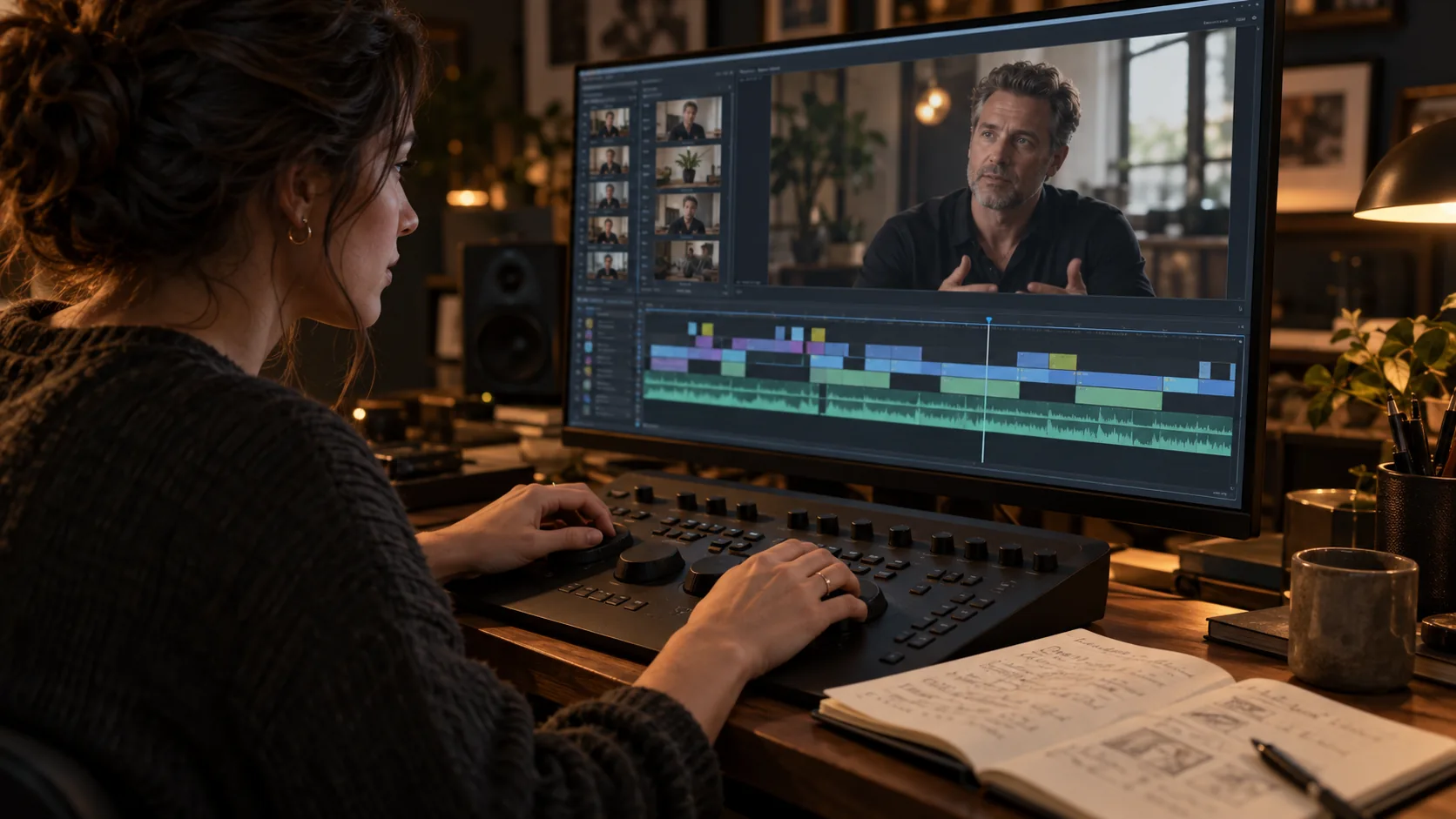
Anyone can generate a video now. That is exactly why a video cut by a person who watched the footage and understood the story is worth more than it was two years ago, not less.
What an editor decides that software cannot
Editing is not trimming. It is judgement. Which of the forty takes has the honesty in it. Where the cut lands so the sentence has weight. How long to hold on a face after someone stops talking, because the silence is saying more than the words did. Whether the drone shot goes first or last. Which sound the viewer should hear under the picture.
Software can assemble clips to a template. It cannot notice that the client’s voice changed when she talked about her first shop, and it cannot decide that the whole video should be built around that moment. That decision is the work.
Audiences are getting quick at spotting it
Generated and template-assembled video has a texture, and people have learned it fast. The pacing is too even. The transitions are too regular. The stock footage does not quite match the voiceover. The captions bounce in the same way on every video from every business. None of that is a crime — but viewers register it, usually without being able to say why, and they scroll.
Real footage of real people, cut with attention, does not trigger that reflex. It holds.
The brand risk nobody prices in
Here is the part that matters commercially. When an audience decides a video is synthetic, the scepticism does not attach to the tool that made it. It attaches to the business that posted it. The unspoken read is: if they cut corners here, where else?
For a tradesperson, a builder, an agent, a venue — businesses whose entire pitch is that you can trust them with something that matters — that is an expensive impression to make for the sake of a cheaper video.
Where automation genuinely helps
None of this is an argument against software. We use it every day — for transcription, for rough captions, for sorting footage, for the first pass at colour matching, for the tedious parts that used to eat hours. The point is that it does the tedious parts so a person can spend the time on the parts that need one. The tool is in the workflow. It is not in the decisions.
How to tell the difference
Ask to see the portfolio, and watch for the things a template cannot do. Does the pacing change when the content does? Do the cuts land on moments rather than on a beat count? Does the video feel like it was made about this business, or could the logo be swapped for a competitor’s without changing anything?
Then ask who edits the work. Not who runs the company — who sits in the chair. If the answer is vague, that is the answer.
Every frame on this site was cut by a person. You can tell — and so can your audience.
3 Points Media Co
Frequently asked questions
Does human editing cost more?
Per video, usually yes. Per result, usually no — because a video people actually watch to the end does the job of several that they scroll past.
Do you use AI tools at all?
For transcription, caption drafts, footage sorting and other mechanical tasks, yes. Not for deciding what the video is or how it is cut.
How can I check if a video company edits by hand?
Watch three of their videos back to back. If they feel like the same video with different footage, they are working to a template. Then ask who does the editing.
Is generated video ever the right choice?
For internal explainers, quick placeholder content, or anything where nobody is being asked to trust the business, it can be fine. For anything customer-facing, we would not.