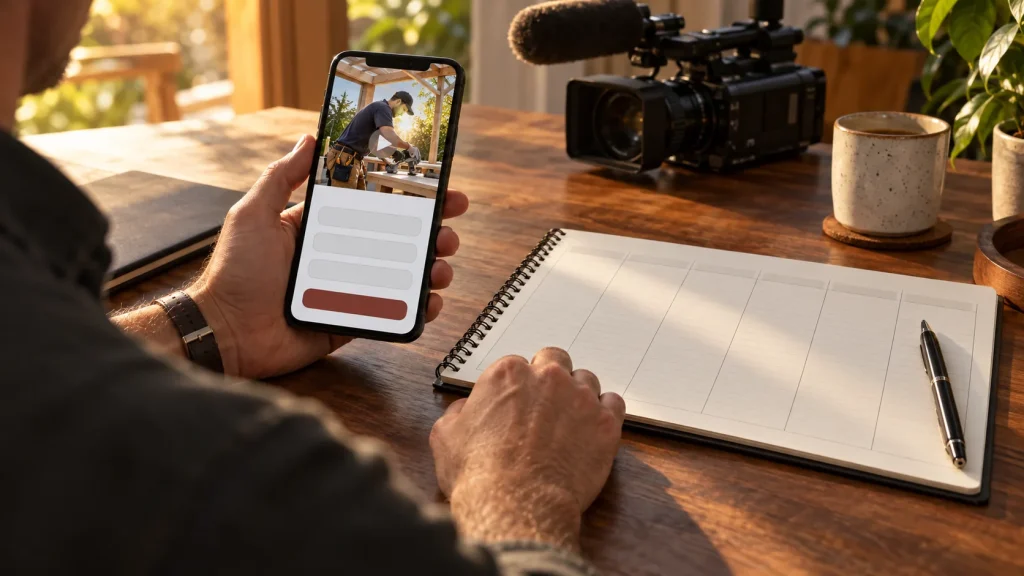

The ad that looks like an ad gets scrolled past. The one that looks like a person talking to their phone gets watched. That is the whole mechanic behind UGC-style advertising, and it changes how you should think about production value.
Why polish stops the scroll — in the wrong direction
People on Instagram and Facebook are not there to watch ads. They are there to watch their friends, their interests, and whatever the algorithm has learned they will not skip. Anything that reads as a commercial — glossy footage, a logo animation, studio lighting, a voiceover — triggers an instant, learned response: keep scrolling.
Footage that looks like it belongs in the feed does not trigger it. A person, a phone, a real room, a sentence that sounds like something someone would actually say. The viewer is three seconds in before they realise it is an ad, and by then the hook has done its job.
What UGC actually means
User-generated content originally meant real customers posting about a product on their own. In advertising it has come to mean content made to look like that — a testimonial, a demo, a day-in-the-life — shot in the native style of the platform rather than the style of television.
The distinction that matters is not who filmed it. It is whether it feels like content or feels like an ad. A business owner talking to camera about a job they just finished, filmed on a phone in the ute, is UGC. The same person in a studio with a teleprompter is not.
Anatomy of a hook
The first two seconds decide everything. A hook is not a logo and it is not a greeting. It is the most interesting sentence in the video, moved to the front.
- A problem the viewer recognises — “If your listing has been up three weeks with no offers…”
- A surprising claim — “This shoot cost less than the agent’s lunch.”
- A visual that needs explaining — a drone shot, a before-and-after, something being done wrong
- A direct question — “Why does every builder’s video look the same?”
We cut three or four hooks for every ad and let Meta tell us which one works. The body of the video stays the same; only the opening changes. That is the cheapest A/B test in marketing.
Filming it on a phone, properly
“Rough” is a look, not a lack of care. Behind a good UGC ad is usually a plan: a clear message, a location that says something about the business, decent sound, and someone comfortable on camera. The phone is a choice because it produces the right texture — not because it was the only thing available.
What actually matters: eye level, natural light from the front, a quiet room, captions on everything, and vertical framing with the subject in the middle third so the ad works across every placement.
When polished still wins
Not every brand should look like a phone video. Prestige property, high-end hospitality, and anything where the product is beauty itself still benefit from cinematic work — the polish is the message. The rule is to match the ad to the feed it is running in and the promise the business is making. A luxury waterfront listing shot on a phone looks cheap. A plumber’s ad shot on a cinema camera looks like it cost more than the plumber.
Most businesses need both: cinematic work for the website and the hero moments, UGC-style cuts for the ads that run every day. One shoot, planned properly, gives you both.
Frequently asked questions
Do I have to be on camera?
Someone does, and it is usually better if it is you or a real member of your team rather than an actor. Nervous is fine. Nobody expects a performance, and the slight awkwardness is part of what makes it believable.
How many versions of an ad do you make?
Typically one body with three or four different hooks, plus a square and a vertical cut of each. Meta needs variety to find what works.
Can I use UGC-style video organically too?
Yes, and you should. The same cut that runs as an ad often performs well as a normal post, which is a useful free test before spending money on it.
Does this replace professional video?
No. It replaces the idea that every video needs to be professional-looking. The two do different jobs.